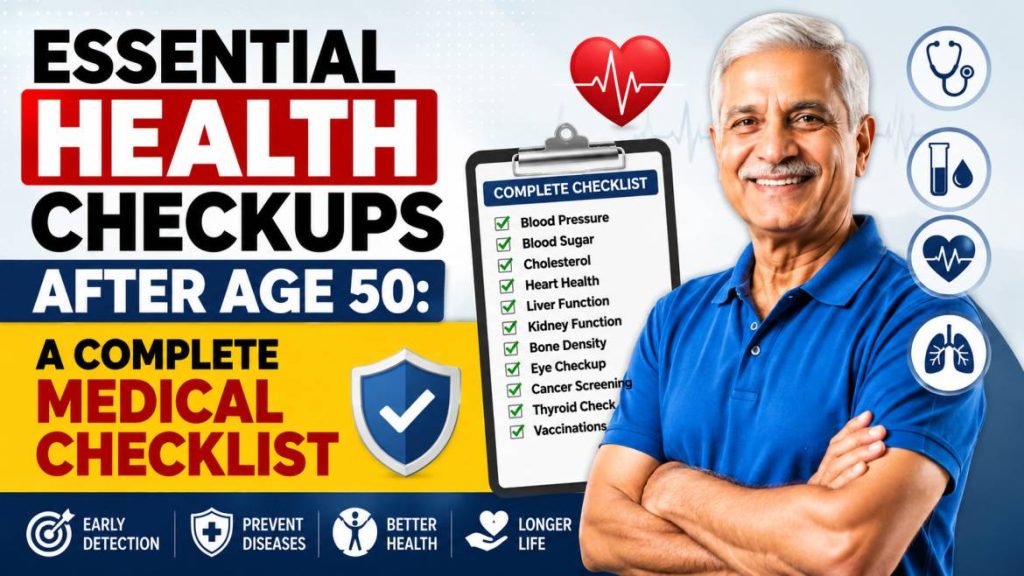

Turning 50 is one of the most beautiful and freeing milestones in a person’s life. By this age, you have gathered immense life experience, your career has stabilized, and you finally have the time to focus on your personal passions. However, your body also starts communicating its needs a little differently. You might notice that your energy levels fluctuate, your joints feel a bit stiff in the morning, or that spicy meal you used to love now causes heavy heartburn. These are completely natural biological shifts.
The best way to celebrate your 50s is by taking proactive control of your well-being. Scheduling essential health checkups after age 50 is not about searching for diseases; it is about finding total peace of mind. By catching minor health shifts early, you can effortlessly prevent serious medical emergencies and continue living a highly active, joyful life with your family.
Unfortunately, many adults ignore routine medical care because they simply feel “fine.” But conditions like high blood pressure, cholesterol, and declining bone density are often silent—they do not show any visible symptoms until a major problem occurs.
Whether you are looking for a comprehensive full body checkup after age 50 for yourself or searching for reliable preventive health tests for seniors to protect your aging parents, having a structured, accurate plan is mandatory. In this detailed medical guide, we have created the ultimate checklist that clearly explains which tests you need, why you need them, and how frequently they should be done.
What essential health checkups after age 50 are necessary?
The most essential health checkups after age 50 include a complete lipid profile, blood sugar screening (HbA1c), bone density testing, and gender-specific cancer screenings like mammograms for women and PSA tests for men.
As our bodies age, our metabolism slows down naturally. Because of this slower digestion and changing hormone levels, the risk of developing lifestyle conditions like type 2 diabetes or cardiovascular blockages increases sharply. When you reach your 50s, a basic fever check or a quick blood pressure reading at a local pharmacy is no longer enough to measure your overall health. Your internal organs—specifically your heart, liver, and kidneys—require a deeper internal evaluation.
Booking essential health checkups after age 50 ensures that doctors have a clear, scientific baseline of how your organs are functioning. If your cholesterol begins to climb slightly, your doctor can immediately guide you to change your cooking oils or add a 30-minute daily walk to your routine, completely avoiding the need for heavy heart medications later. A properly structured health screening checklist for over 50 is essentially a protective shield. It empowers you to enjoy your retirement years safely, travel comfortably, and play with your grandchildren without physical limitations or hidden health fears.
Which essential health checkups after age 50 should be included in your annual blood tests?
Your annual blood work should strictly include a Lipid Profile for heart health, an HbA1c test for hidden diabetes, Kidney and Liver Function Tests, along with Vitamin D and B12 panels to prevent bone weakness and severe fatigue.
When you sit down with a physician to design your annual health checkup above 50, blood tests will form the core foundation of your diagnosis. Blood tells the absolute truth about what is happening inside your arteries and organs. Below is the detailed health screening checklist for over 50 regarding blood work that you must strictly follow:
- Lipid Profile (Cholesterol Test): This test measures your good cholesterol (HDL) and bad cholesterol (LDL). As you age, bad cholesterol tends to stick to the walls of your arteries, making them narrow and increasing the risk of a sudden heart attack. Checking this annually keeps your heart safe.
- HbA1c (Fasting Blood Sugar): A standard finger-prick test is not enough. The HbA1c test calculates your average blood sugar levels over the past three months. It is the most accurate way to detect prediabetes before it causes permanent nerve or vision damage.
- Liver and Kidney Function Tests (LFT & KFT): Your liver and kidneys are the primary filters of your body. Because many adults regularly consume painkillers for joint pain or acidity medicines, these organs take a heavy load. A basic KFT and LFT catch early signs of organ fatigue or fatty liver perfectly.
- Vitamin D and B12 Panel: As you cross 50, your stomach’s ability to absorb essential vitamins from food drops significantly. A massive drop in Vitamin B12 causes memory loss and severe body pain, while low Vitamin D leads to direct bone loss and fractures.
- Thyroid Function Test (TSH): Especially critical for women, thyroid imbalances after 50 can cause extreme weight gain, sudden hair loss, and deep depression.
What are the mandatory health screenings for women over 50?
Women over 50 must undergo regular mammograms to check for breast cancer, a DEXA scan to measure bone strength, and a Pap smear combined with an HPV test to detect early cervical cell changes.
When a woman enters her 50s, she is usually experiencing menopause or has recently completed it. The sudden drop in estrogen hormones highly affects her bone strength, heart protection, and emotional balance. Therefore, the medical tests for 50 year old woman must heavily focus on post-menopausal changes.
Firstly, bone health becomes a massive priority. Estrogen protects bones, and without it, women lose bone mass incredibly fast, leading to osteoporosis. A painless Bone Density Test (DEXA scan) is absolutely mandatory to check if your bones are becoming hollow or brittle. If caught early, calcium supplements and light strength training can reverse the damage.
Secondly, cancer risk changes as a woman ages. Regular mammograms are highly advised every one to two years to catch any tiny lumps in the breast tissues long before they can be felt by a physical touch. Additionally, women must not ignore their gynecological health simply because their periods have stopped. A Pap smear, done every three to five years by a trusted gynecologist, guarantees that the cervix is healthy and completely free from any precancerous cells.
What are the essential health tests for men above 50?
Men above 50 must complete a Prostate-Specific Antigen (PSA) blood test, an Electrocardiogram (ECG) to monitor hidden heart stress, and a thorough colon cancer screening.
Men often avoid visiting hospitals unless they are in extreme pain. This habit is highly dangerous during their 50s because male health issues develop silently in the background. The medical tests for 50 year old man must aggressively target cardiovascular health and prostate function, which are the two biggest risk areas for aging males.
The prostate gland naturally enlarges as a man ages. This causes highly irritating symptoms like waking up multiple times at night to pass urine or feeling a burning sensation. Every man crossing 50 must request a Prostate-Specific Antigen (PSA) blood test from their doctor. A high PSA score serves as an early warning indicator for prostate swelling, infections, or prostate cancer, allowing a urologist to fix the problem instantly with medication.
Because men are biologically at a higher risk for sudden cardiac events, resting blood pressure checks and an Electrocardiogram (ECG) are mandatory. If a man has a history of smoking, doctors also strongly advise a lung screening and an Ankle-Brachial Index (ABI) test to ensure the blood vessels in the legs are not blocking up.
How often should someone over 50 get a full body checkup?
You should ideally get a full body checkup once every year. Having all your tests done annually creates a reliable medical history that helps your doctor instantly spot any dangerous changes in your health.
Consistency is the absolute secret to healthy aging. You cannot get tested once at age 50 and assume you are protected until you reach 60. Taking an annual health checkup above 50 gives your family total control over your health trajectory. However, running from a separate blood laboratory to a radiology center, and then to a heart specialist, can be exhausting for older adults.
For maximum comfort, you must rely on an advanced, fully equipped medical facility. For families in Western UP, Lokpriya Hospital in Meerut serves as the most trusted center for these highly sensitive evaluations.
They offer highly curated executive health checkup packages that bundle all these vital tests into a single morning visit. With a highly advanced in-house pathology lab, high-resolution radiology machines for your DEXA scans and ultrasounds, and top-tier senior physicians available 24/7, you do not have to stress about standing in separate queues. Completing your preventive health tests for seniors at a unified, top-tier hospital like Lokpriya guarantees 100% accurate lab reports and immediate, expert consultations right on the spot.
Why is colon cancer screening important after age 50?
Colon cancer screening is critical after age 50 because intestinal polyps (small growths) often develop silently without causing any stomach pain or bleeding, and they can turn cancerous if not removed early.
Many people feel highly embarrassed or scared to talk about their bowel movements, but protecting your colon is a major part of your full body checkup after age 50. As digestion slows down with age, the inner lining of the large intestine can develop tiny, painless growths called polyps.
Doctors highly recommend a colonoscopy for both men and women once they hit 50. During this simple, painless procedure, a gastroenterologist examines the intestine using a tiny camera. If they spot any suspicious polyps, they can remove them right then and there. This essentially stops colon cancer from ever forming. It is one of the most powerful and effective preventive measures available in modern medicine.
Frequently Asked Questions (FAQs)
Does a full body checkup after age 50 include an ECG?
Yes, a proper full body checkup after age 50 always includes an Electrocardiogram (ECG). This simple, painless test records the electrical signals of your heart to detect any hidden stress, irregular heartbeats, or signs of past silent heart attacks.
Can Lokpriya Hospital perform all senior health screenings in one day?
Absolutely. Lokpriya Hospital is fully equipped with highly advanced in-house pathology, cardiology, and radiology departments. They provide dedicated preventive health packages allowing patients to finish all their blood work, ultrasounds, and doctor consultations smoothly under one single roof in just a few hours.
Do I need to fast before my annual health checkup above 50?
Yes, strict fasting is normally required. Tests like the Lipid Profile (cholesterol test) and the fasting blood sugar test require you to stop eating and drinking anything except plain water for 10 to 12 hours beforehand to guarantee perfectly accurate results.
Are bone density tests painful for older women?
Not at all. A bone density test, commonly called a DEXA scan, is completely painless and non-invasive. You simply lie down on a comfortable medical table while a scanner passes over your body. It uses very low-dose X-rays and finishes in about 10 to 15 minutes.
Why do I need a Vitamin B12 test if I eat a healthy diet?
As your stomach ages, its biological ability to absorb Vitamin B12 from normal food drops significantly, even if you eat a highly nutritious diet. A B12 deficiency leads to intense fatigue, memory issues, and nerve pain, which is why checking its levels directly through a blood test is highly advised.